import {vertex} from '@tools/fragments';
import perlin from './perlin.frag';
import fragment from './gorday.frag';
import {Filter} from '@pixi/core';
import {Point, DEG_TO_RAD} from '@pixi/math';
/**
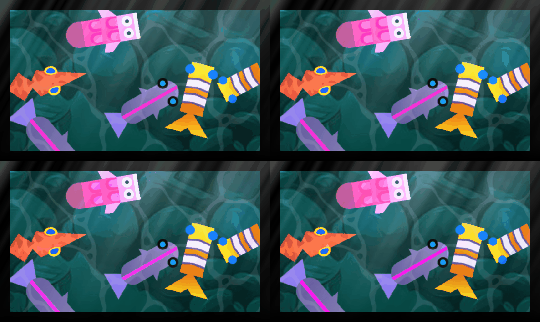
* GordayFilter, {@link https://codepen.io/alaingalvan originally} by Alain Galvan
*
*
*
* 
* @class
* @extends PIXI.Filter
* @memberof PIXI.filters
* @see {@link https://www.npmjs.com/package/@pixi/filter-godray|@pixi/filter-godray}
* @see {@link https://www.npmjs.com/package/pixi-filters|pixi-filters}
*
* @example
* displayObject.filters = [new GodrayFilter()];
* @param {object} [options] Filter options
* @param {number} [options.angle=30] Angle/Light-source of the rays.
* @param {number} [options.gain=0.5] General intensity of the effect.
* @param {number} [options.lacunrity=2.5] The density of the fractal noise.
* @param {boolean} [options.parallel=true] `true` to use `angle`, `false` to use `center`
* @param {number} [options.time=0] The current time position.
* @param {PIXI.Point|number[]} [options.center=[0,0]] Focal point for non-parallel rays,
* to use this `parallel` must be set to `false`.
* @param {number} [options.alpha=1.0] the alpha, defaults to 1, affects transparency of rays
*/
class GodrayFilter extends Filter {
constructor(options) {
super(vertex, fragment.replace('${perlin}', perlin));
this.uniforms.dimensions = new Float32Array(2);
// Fallback support for ctor: (angle, gain, lacunarity, time)
if (typeof options === 'number') {
// eslint-disable-next-line no-console
console.warn('GodrayFilter now uses options instead of (angle, gain, lacunarity, time)');
options = { angle: options };
if (arguments[1] !== undefined) {
options.gain = arguments[1];
}
if (arguments[2] !== undefined) {
options.lacunarity = arguments[2];
}
if (arguments[3] !== undefined) {
options.time = arguments[3];
}
if (arguments[4] !== undefined) {
options.alpha = arguments[4];
}
}
options = Object.assign({
angle: 30,
gain: 0.5,
lacunarity: 2.5,
time: 0,
parallel: true,
center: [0, 0],
alpha: 1,
}, options);
this._angleLight = new Point();
this.angle = options.angle;
this.gain = options.gain;
this.lacunarity = options.lacunarity;
this.alpha = options.alpha;
/**
* `true` if light rays are parallel (uses angle),
* `false` to use the focal `center` point
*
* @member {boolean}
* @default true
*/
this.parallel = options.parallel;
/**
* The position of the emitting point for light rays
* only used if `parallel` is set to `false`.
*
* @member {PIXI.Point|number[]}
* @default [0, 0]
*/
this.center = options.center;
/**
* The current time.
*
* @member {number}
* @default 0
*/
this.time = options.time;
}
/**
* Applies the filter.
* @private
* @param {PIXI.FilterManager} filterManager - The manager.
* @param {PIXI.RenderTarget} input - The input target.
* @param {PIXI.RenderTarget} output - The output target.
*/
apply(filterManager, input, output, clear) {
const {width, height} = input.filterFrame;
this.uniforms.light = this.parallel ? this._angleLight : this.center;
this.uniforms.parallel = this.parallel;
this.uniforms.dimensions[0] = width;
this.uniforms.dimensions[1] = height;
this.uniforms.aspect = height / width;
this.uniforms.time = this.time;
this.uniforms.alpha = this.alpha;
// draw the filter...
filterManager.applyFilter(this, input, output, clear);
}
/**
* The angle/light-source of the rays in degrees. For instance, a value of 0 is vertical rays,
* values of 90 or -90 produce horizontal rays.
* @member {number}
* @default 30
*/
get angle() {
return this._angle;
}
set angle(value) {
this._angle = value;
const radians = value * DEG_TO_RAD;
this._angleLight.x = Math.cos(radians);
this._angleLight.y = Math.sin(radians);
}
/**
* General intensity of the effect. A value closer to 1 will produce a more intense effect,
* where a value closer to 0 will produce a subtler effect.
*
* @member {number}
* @default 0.5
*/
get gain() {
return this.uniforms.gain;
}
set gain(value) {
this.uniforms.gain = value;
}
/**
* The density of the fractal noise. A higher amount produces more rays and a smaller amound
* produces fewer waves.
*
* @member {number}
* @default 2.5
*/
get lacunarity() {
return this.uniforms.lacunarity;
}
set lacunarity(value) {
this.uniforms.lacunarity = value;
}
/**
* The alpha (opacity) of the rays. 0 is fully transparent, 1 is fully opaque
* @member {number}
* @default 1
*/
get alpha() {
return this.uniforms.alpha;
}
set alpha(value) {
this.uniforms.alpha = value;
}
}
export { GodrayFilter };